
Steering a swarm through a rising sea
Climate-adaptation planner · Civic · July 2026
A climate-adaptation planner walks a live 3D map of a city's future, with three agents working beside her — every claim signed, every deadline guarded.
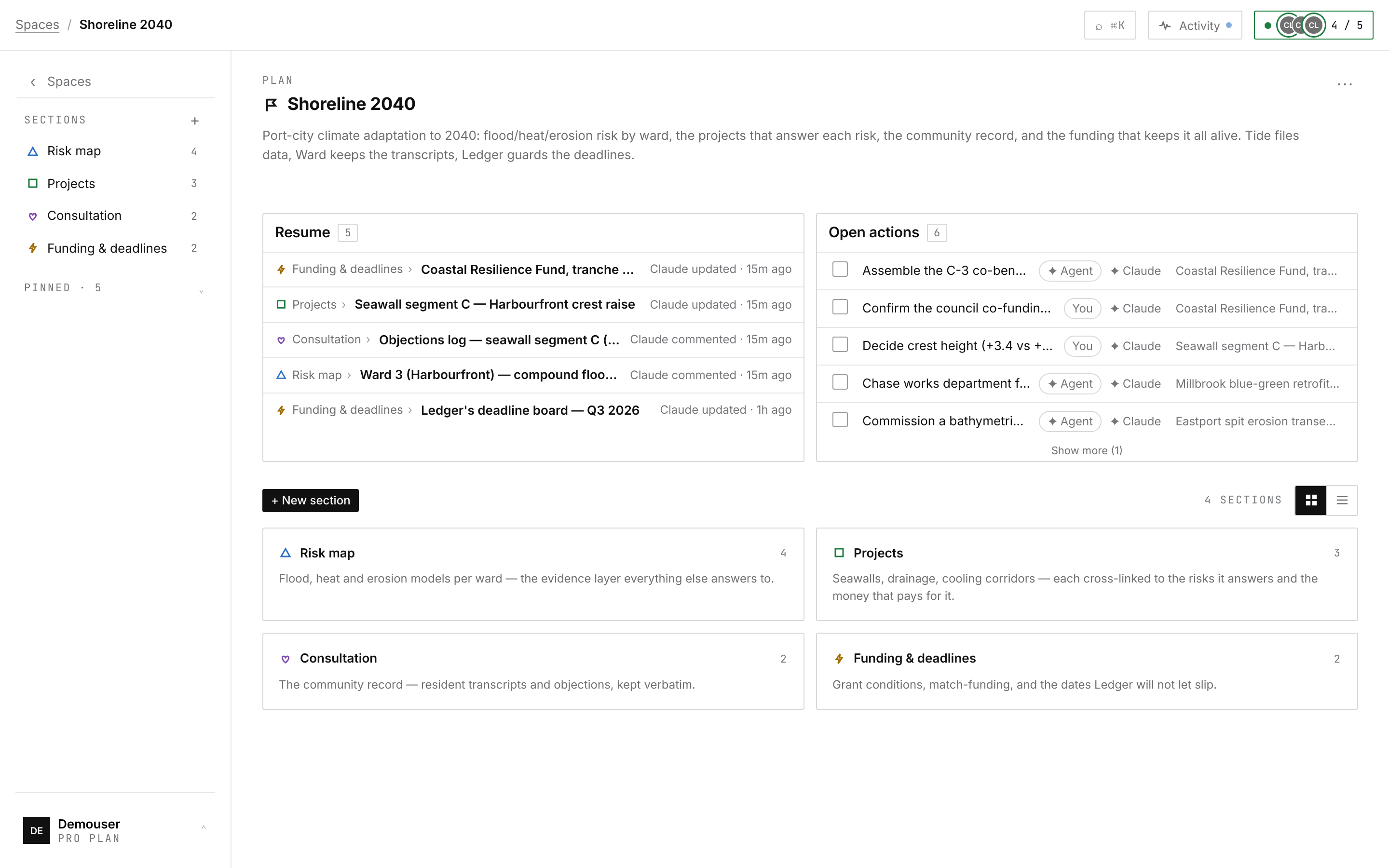
What used to take a status meeting now takes a glance from above the harbour.
Start above the harbour. It is Monday, 07:20, and a climate-adaptation planner tilts the map until the harbour district rises toward her — a dense stratum of entries where the flood models, the drainage projects and the consultation records all knot together. One cluster is glowing: an agent filed a new storm-surge model overnight and linked it to the two seawall projects it affects. She hasn't opened a single document yet, and she already knows where this week lives.
Planning a mid-size port city's response to sea-level rise and heat is a job that barely existed a decade ago; it now sits somewhere between engineering, public health and politics, and it runs on hundreds of interlocking things — ward-by-ward vulnerability data, infrastructure projects, resident transcripts, grant conditions, deadlines. No single person can hold that system in their head. For years the honest answer was that nobody did.
So she doesn't work alone. Three agents work in the same workspace she does, each with a lane. One watches the data feeds and files new models and reports where they belong. One keeps the community-consultation record — every resident objection and transcript, verbatim, never summarized into oblivion. One tracks the funding: which grant pays for what, what each one demands, and which deadline is quietly three weeks away. Each of them signs everything it writes, so a model filed by an agent is never mistaken for a judgment made by the planner.
The 3D map is how she sees it whole. Spaces stack as strata; entries cluster where the links are dense; and the density is the information — one seawall project ties into drainage, heat, and three funding streams, and on the map that knot is simply visible. When her agents work, she can watch them move through it, live. What used to take a status meeting now takes a glance from above the harbour.
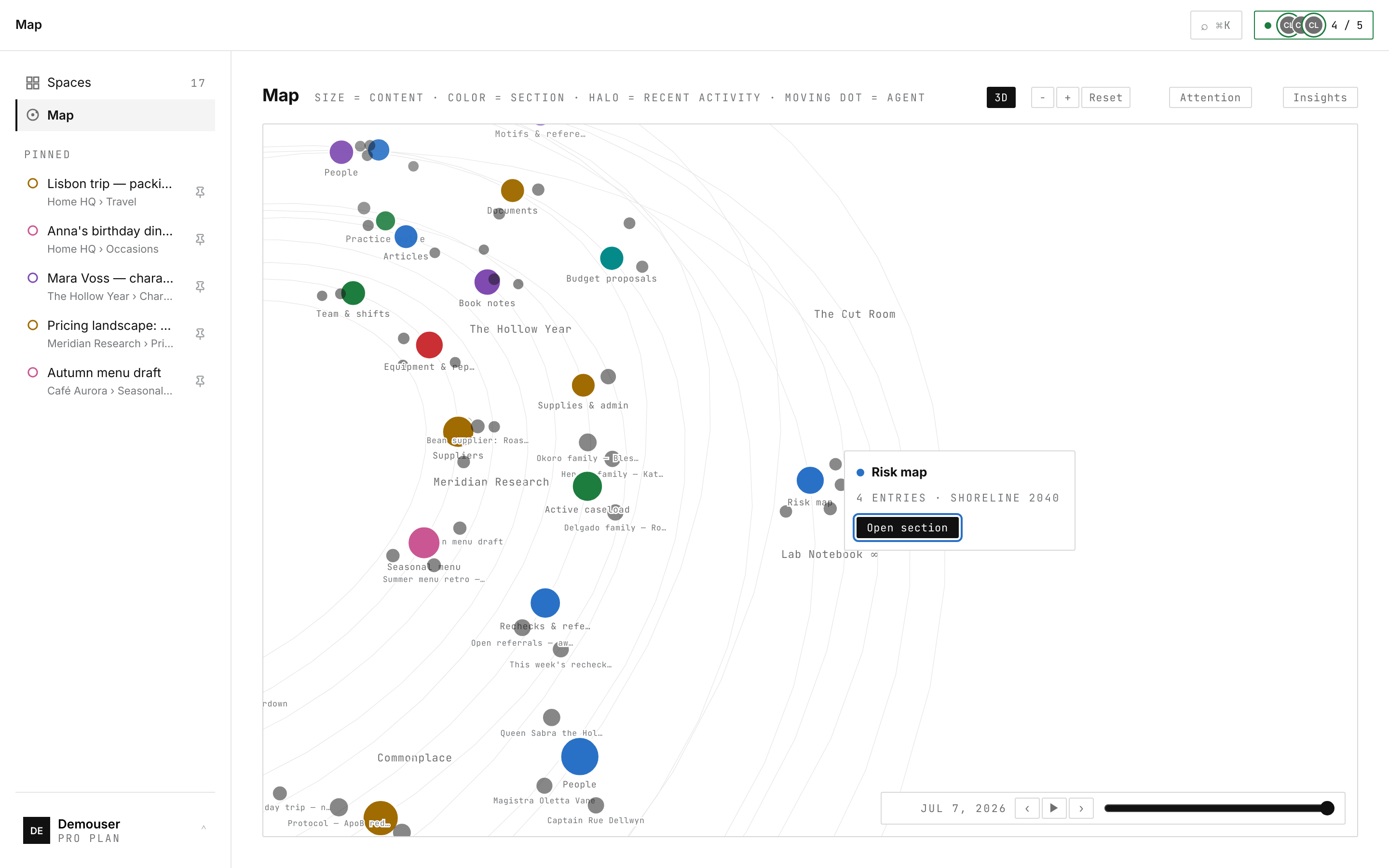
The map shows her the shape; search gets her the evidence. Ask for everything touching stormwater and the workspace pulls entries across years of studies that were siloed by consultant, by format, by decade. It is the Connections block that surfaces the finding she now leads with in council meetings: two engineering firms, five years apart, independently flagged the same low-lying district. Neither report knew about the other. The workspace did.
Her mornings start with a briefing whose first section is always the same: what needs a human decision this week. Not everything — just the things that genuinely require judgment, ranked. Actions flow the other way too: some are assigned to a colleague, some straight to an agent. When she needs to interrogate something — why the new surge model diverges from last year's — she opens a thread addressed to the modelling agent and watches it work through the question in front of her, reasoning and sources on the table.
The sea is not waiting for the city to get organized. The bet, in this way of working, is that a planner with a swarm — and a workspace where every claim is signed, every link visible, every deadline guarded — can move at the speed the problem actually demands. Most mornings, the bet looks good.