
Seeing the family that got scattered
Family archivist · Care · July 2026
The agent files the scraps and links the records; the living map finally shows a family archivist the shape of everyone.
Two people carried as strangers for a decade became one man with a whole life.
The scan arrives on a Thursday from a second cousin half a world away: a ship manifest from 1923, the family surname misspelled the way officials always misspelled it, a line of names in fading typescript. The family archivist has been waiting nine years for this page. She drops it into her capture inbox and goes to make tea. By the time the tea has steeped, her agent has filed the scan, transcribed the names, and linked the manifest to four people in her archive and to the port they left from.
She has spent fifteen years reconstructing a family that a hard century scattered across four continents, from census scraps, parish registers, a shoebox of photographs and oral histories in three languages. Genealogy has always been a knowledge graph in disguise; her old software knew it, technically, and buried the family in a database she could query but never see. Fifteen years of work, and she could not stand back from any of it.
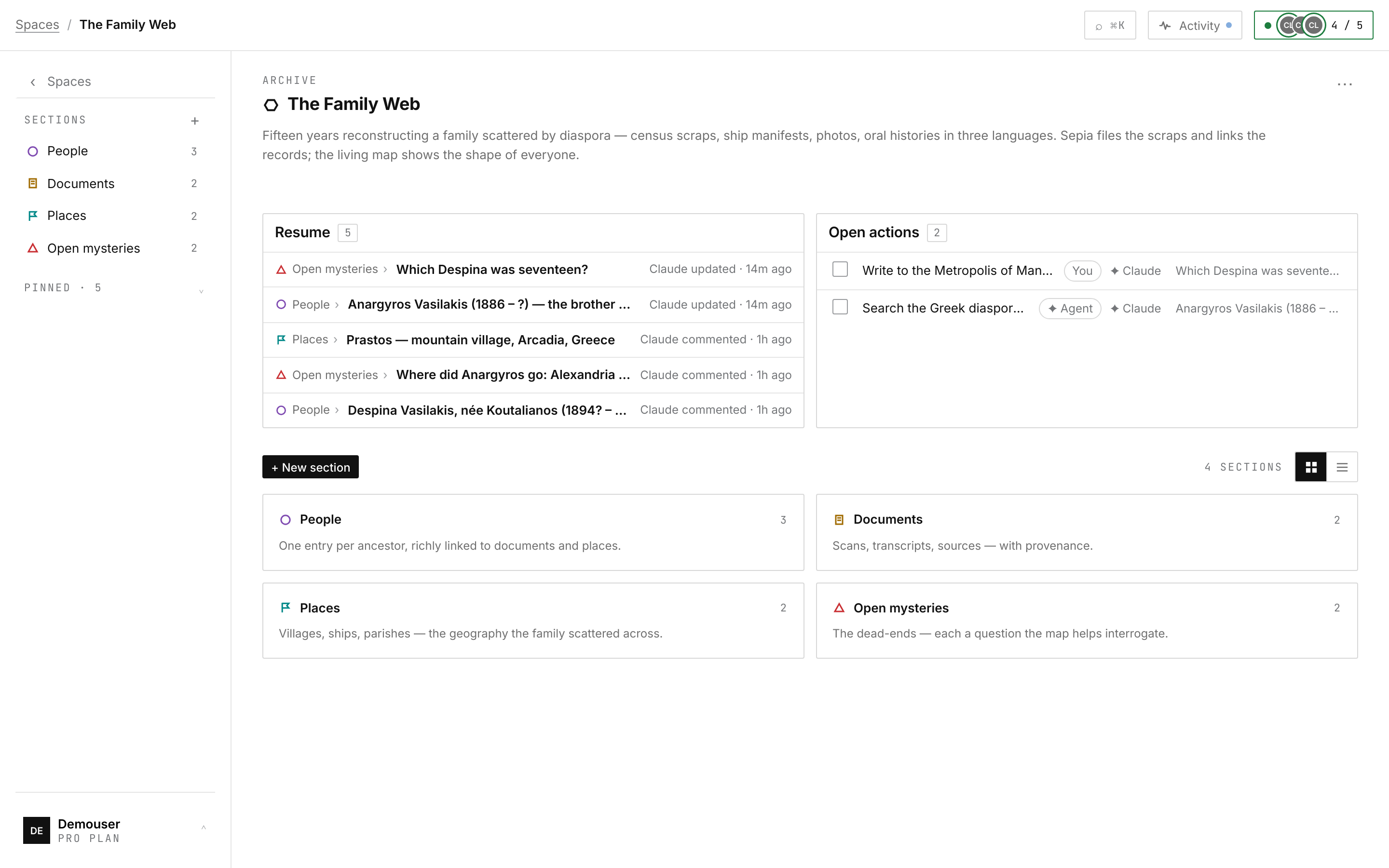
In her workspace, every person, place and document is an entry, and the links between them are the archive: a birth record wired to a person, the person to a village, the village to the ship. On the living map the family finally has a shape — clusters where the record is rich, long threads where a branch emigrated, and the conspicuous gaps where a line simply stops. One of those gaps has a name, and she has been circling it for a decade. Now she can see exactly which documents ring its edges.
The agent does the labour that used to swallow whole winters: filing each new scan, transcribing it, linking it to the people and places it mentions. But the rule that earns the trust is what the agent will not do. When a new source contradicts an established date — and in every family the same wedding exists in two decades, depending on whom you ask — the agent never corrects the record. It leaves a comment on the entry, citing the new source, and waits. In genealogy, provenance is everything; one confident wrong correction can send a decade of research down a false line. The verified tree stays hers, and version history stands behind it in case anything slips.
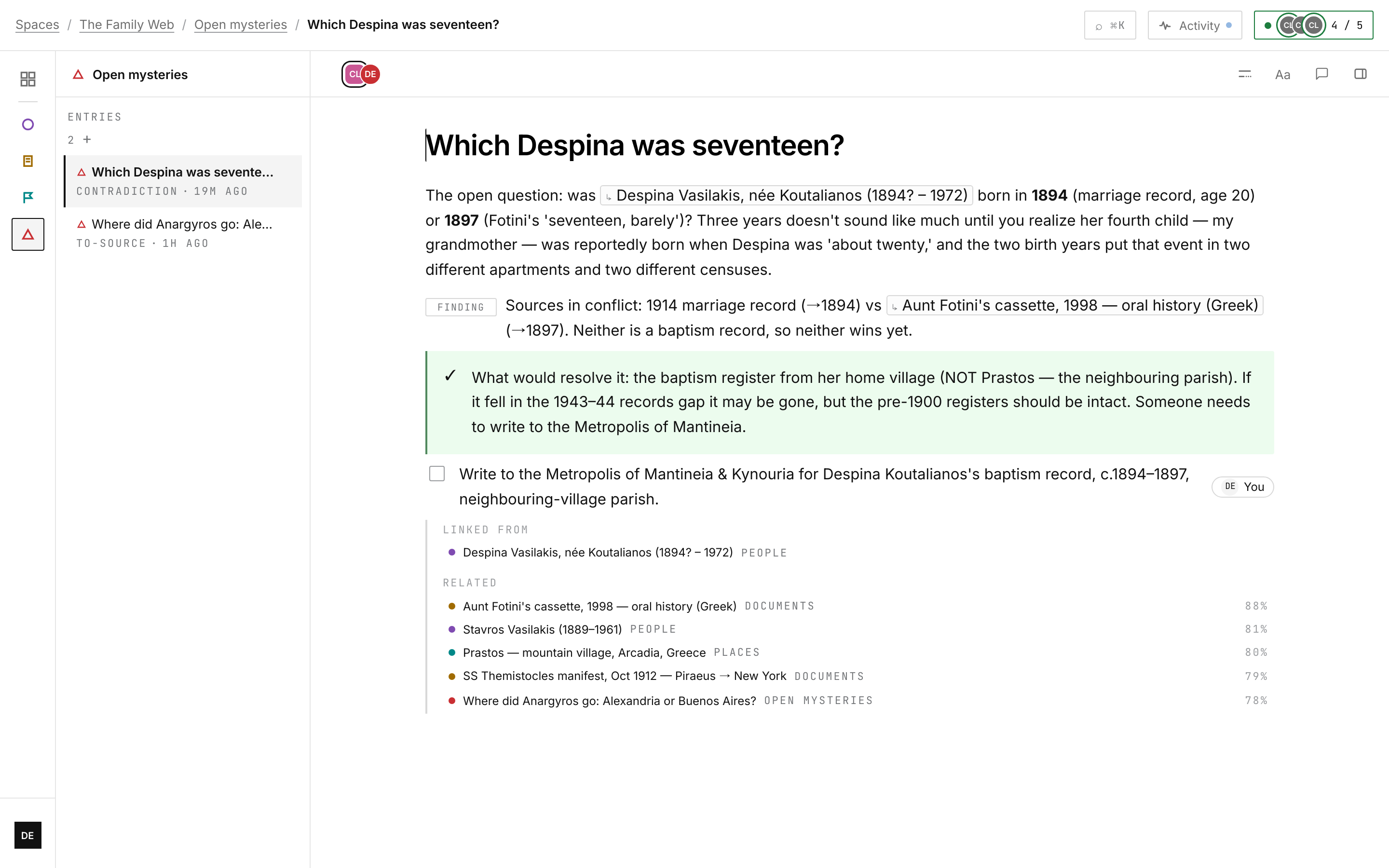
Search understands what her sources meant, not just what they typed. The two cousins who described the same wedding fifty years apart — one in Greek, one in broken English, neither naming the date — surfaced together in one search, and the Connections block now holds them side by side under the marriage they both remember differently.
The best day of the spring came from the shelf. The agent had noticed that a man on a 1931 factory roster and a man in a 1958 obituary — the same surname, differently anglicized — shared an address, a wife's name, and a ship. It did not merge them; suspicion is not proof. It left the finding on the surprise shelf like a small wrapped gift. She spent a weekend confirming it. Two people she had carried as strangers for a decade became one man with a whole life.
The archive will outlive her; that is the point of it. What she is building now, entry by linked entry, is the version of the family that can be seen — by the grandchildren, eventually, and until then by the one person who spent fifteen years learning its shape by heart.