
A build log that holds up in court
Timber-frame restorer · Trades · July 2026
Muddy site photos become a signed, versioned build record — so “when did we find the rot?” has one honest answer.
The notebook was usually right. It just wasn't provable.
Take a timber-frame restorer on a Tuesday morning, a little after eight, in the roof of a barn that was already old when the parish records began. He pulls back a board, runs a thumb along a tie-beam, and finds what two centuries of damp have been quietly doing to the oak. He photographs it, drops the picture into his capture inbox, and types three words: north tie, rot. Then he goes back to work, because the scaffolding is rented by the day.
Heritage restoration — barns, church roofs, the occasional mill — is a trade where the record is not a diary, it is evidence. Every joint cut may have to be defended to a conservation officer years later. Every hidden defect uncovered changes the price of the job, and someone will eventually ask when, exactly, it was found. For decades the answer has lived in a battered notebook and a camera roll ten thousand photos deep. The answer was usually right. It just wasn't provable.
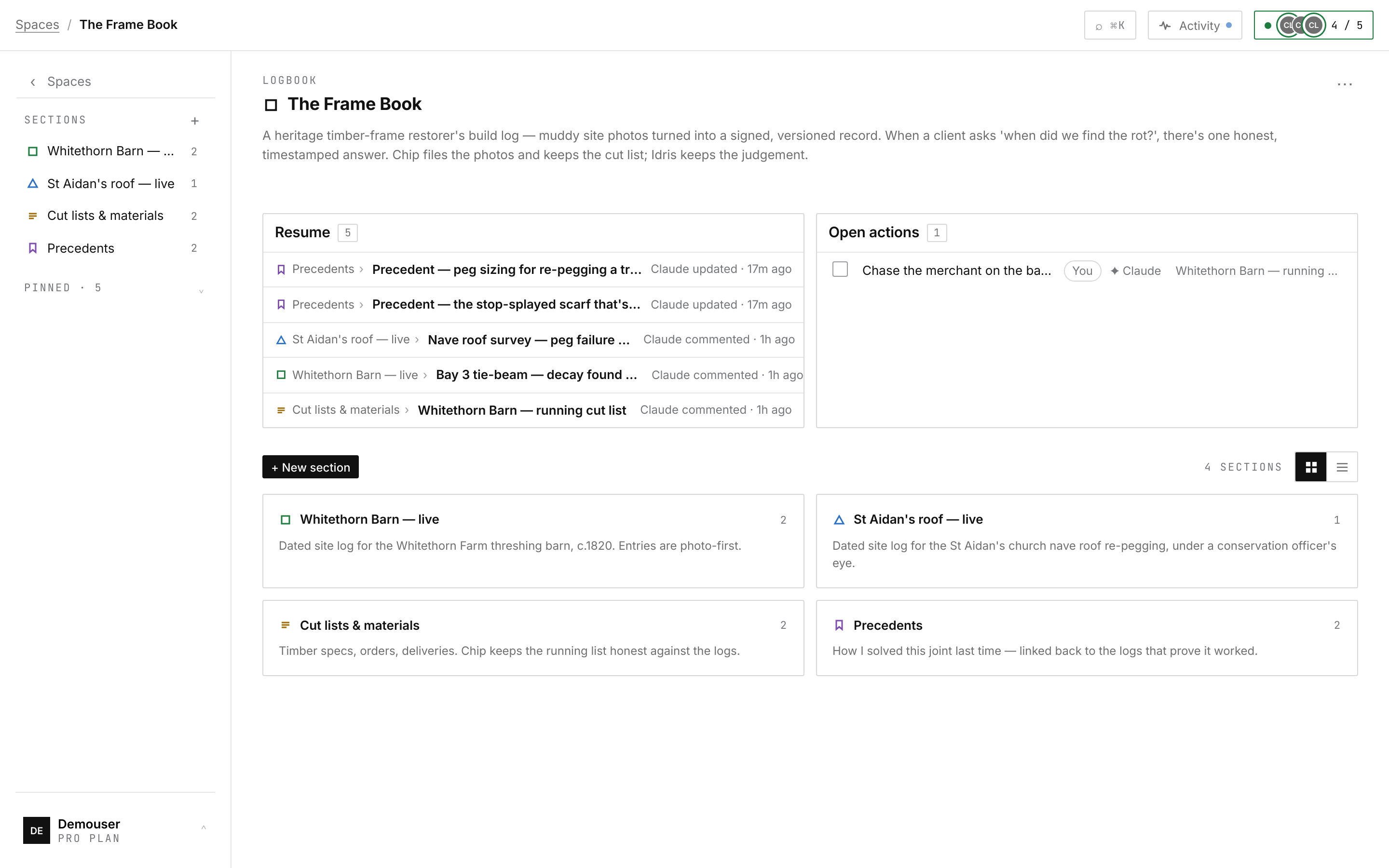
The agent's job is the book-keeping a restorer never had an apprentice for. The photo from the barn is filed within the hour: under the right building, dated, captioned from his three words, with a thumbnail on the card. A section of forty timber joints reads as a wall of photographs — which is how a carpenter actually thinks about a frame, joint by joint, not as a grey list of filenames. The workspace looks like the job.
The proof comes the day a client disputes a change order on a church roof. The claim: the decay was known from the start and priced in. The restorer opens the entry's version history in the meeting — the survey notes from March with no mention of it, then the entry from the sixth of May: photograph, three words, signed and timestamped the day the board came off. Nobody has edited it since; the history would show that too. The meeting gets shorter.
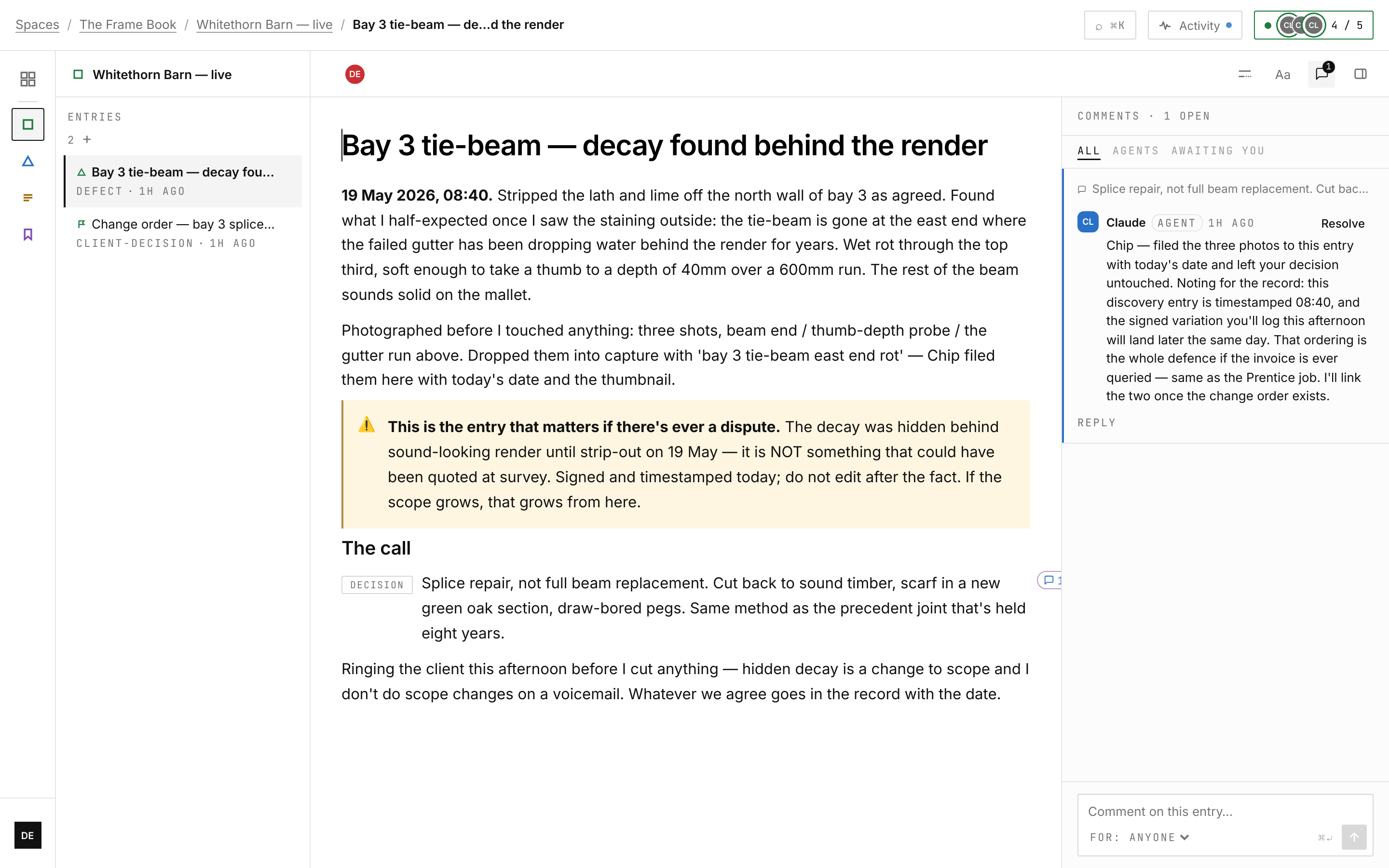
The agent also keeps the running materials list, and it reads the log more carefully than a tired carpenter at the end of a long day. When the entry for a repair says oak and the cutting list says larch, the agent doesn't fix either one — it leaves a comment on the entry pointing at the mismatch, and the human makes the call from the van the next morning. Delivery deadlines become actions with dates, so the order that should have gone in on Friday actually goes in on Friday.
Nobody in this trade goes looking for software. What a restorer is looking for is something a notebook could never do: hold its shape under pressure, years later, in front of people with opinions. A signed entry that says what was found, when, by whom, with the photograph attached — and an agent that keeps the ledger honest without ever touching his words — turns out to be exactly that.
The barn will take most of the year. The tie-beam is already in the book: dated, pictured, signed. Whatever question arrives in five years, the answer is one entry away, and it will say the same thing then that it says today.