
Your world, finally explorable
Game master · Creative · July 2026
A homebrew universe becomes a living galaxy — and the agent flags the plot hole before the players do.
Every worldbuilder knows the cold moment when a player remembers something you don't.
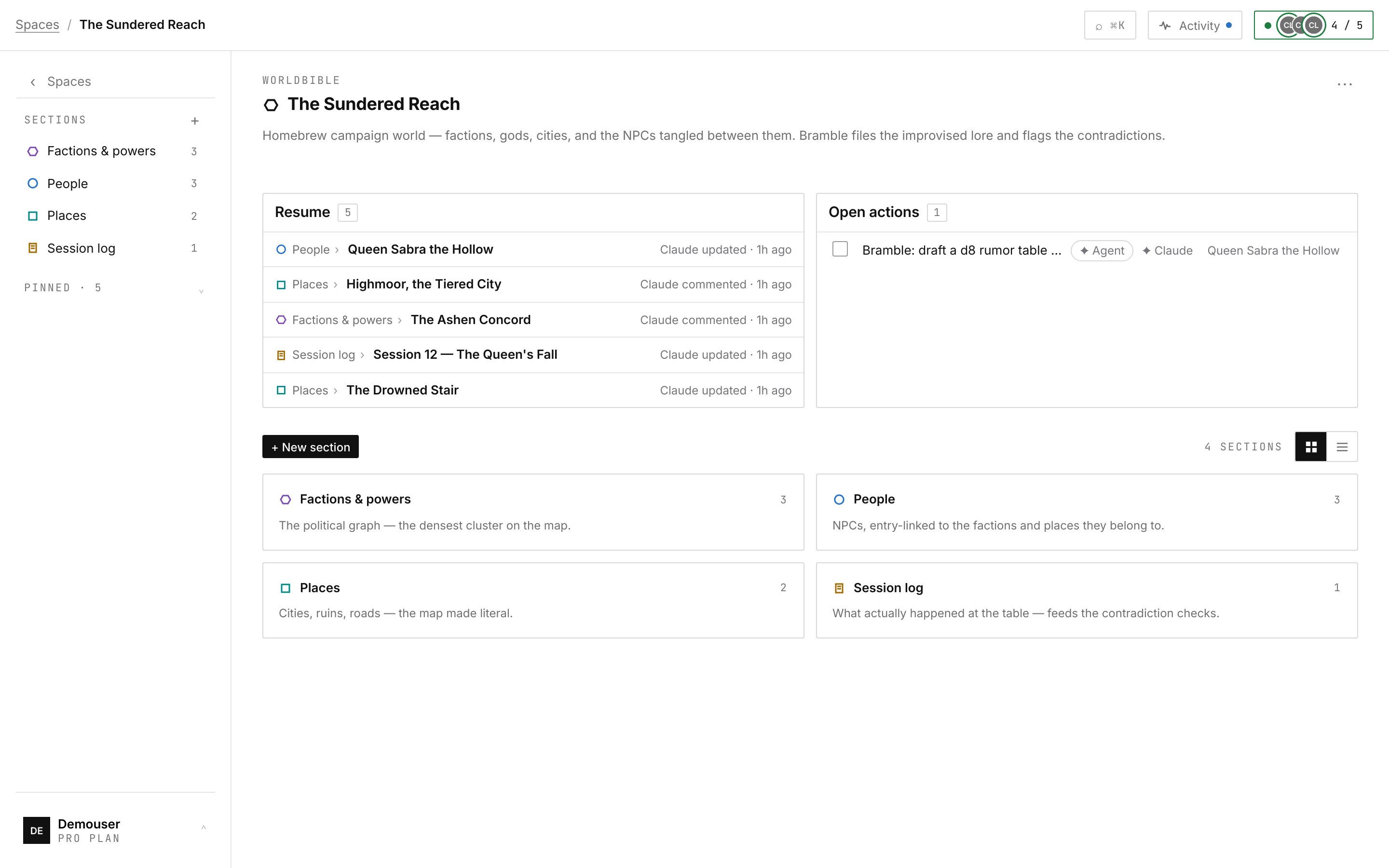
It happens forty minutes into every session: the players ignore the plot and ask the ferryman his name. The game master invents one on the spot — Old Casker, owes money to the Salt Guild, hates the bridge — and keeps the scene moving while his other hand types five words into capture. By the time the party makes camp, the agent has filed Old Casker into the world: a new entry under People, linked to the Salt Guild, linked to the crossing, ready to be canon.
Four years of a homebrew campaign — a world of factions, gods, dead empires and several hundred named characters — is the kind of obsessive interlinked lore that turns game masters into unpaid librarians. The lore was never the problem; the problem is that it lives in seven places and agrees with itself in none of them. Every worldbuilder knows the cold moment when a player remembers something you don't.
Now the world is one workspace, and the links are the world. Factions connect to the people sworn to them, people to places, places to the sessions where the players burned them down. On the knowledge map the setting is a galaxy he can actually fly through — the political clusters, the tangled allegiances, the lonely entries at the rim that he seeded three campaigns ago and never paid off. When he wants to impress a new player, he opens the 3D view and lets them orbit the world their character is about to enter.
The agent's finest work is the contradiction flag. After a session, it checks new lore against old and leaves comments where they collide: you said the queen was dead in session 12. It never fixes anything on its own — a game master's contradictions are sometimes secret doors, and only the GM knows which — so the comment sits there like a raised eyebrow until he rules. Half the time the answer is an erratum. The other half, it becomes a plot: the queen's death, it turns out, was misreported by someone with reasons.
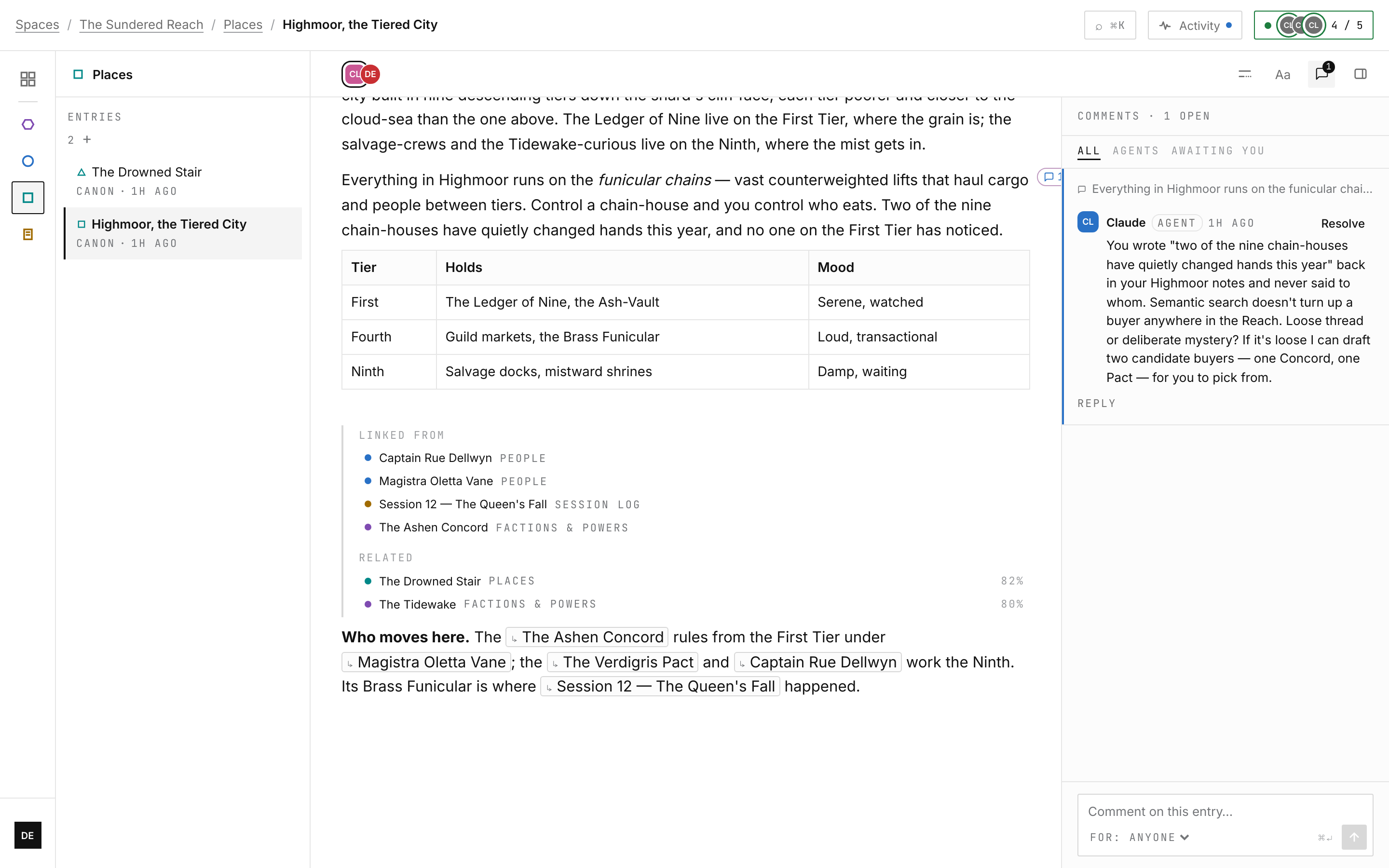
The old fear — the forgotten thread — quietly inverts. Searching by meaning, plus the Connections block on every entry, keeps surfacing the hooks he planted and lost: the debt from the first year that the ferryman's guild could plausibly hold, the prophecy nobody has cashed in. Ghost text helps him draft lore at speed in his own voice, covers give every faction and ruin a face, and empty sections greet him with Ato instead of a blank page, which at midnight before a session is worth more than it sounds.
Some mornings the agent leaves a rumor table on the surprise shelf, generated from whatever the players actually did that week — six things the world is saying about them, ready to be read aloud in a tavern. It is the one piece of the world the GM lets himself be surprised by.
Old Casker, for the record, is now load-bearing: the debt the agent linked him to became the season's opening arc. The players believe it was planned a year in advance. The workspace knows better, and it isn't telling.