
A council office that keeps its promises
City-council member · Civic · July 2026
Every town-hall pledge becomes a tracked, signed commitment — so nothing owed to a resident slips.
Trust, it turns out, has an audit trail.
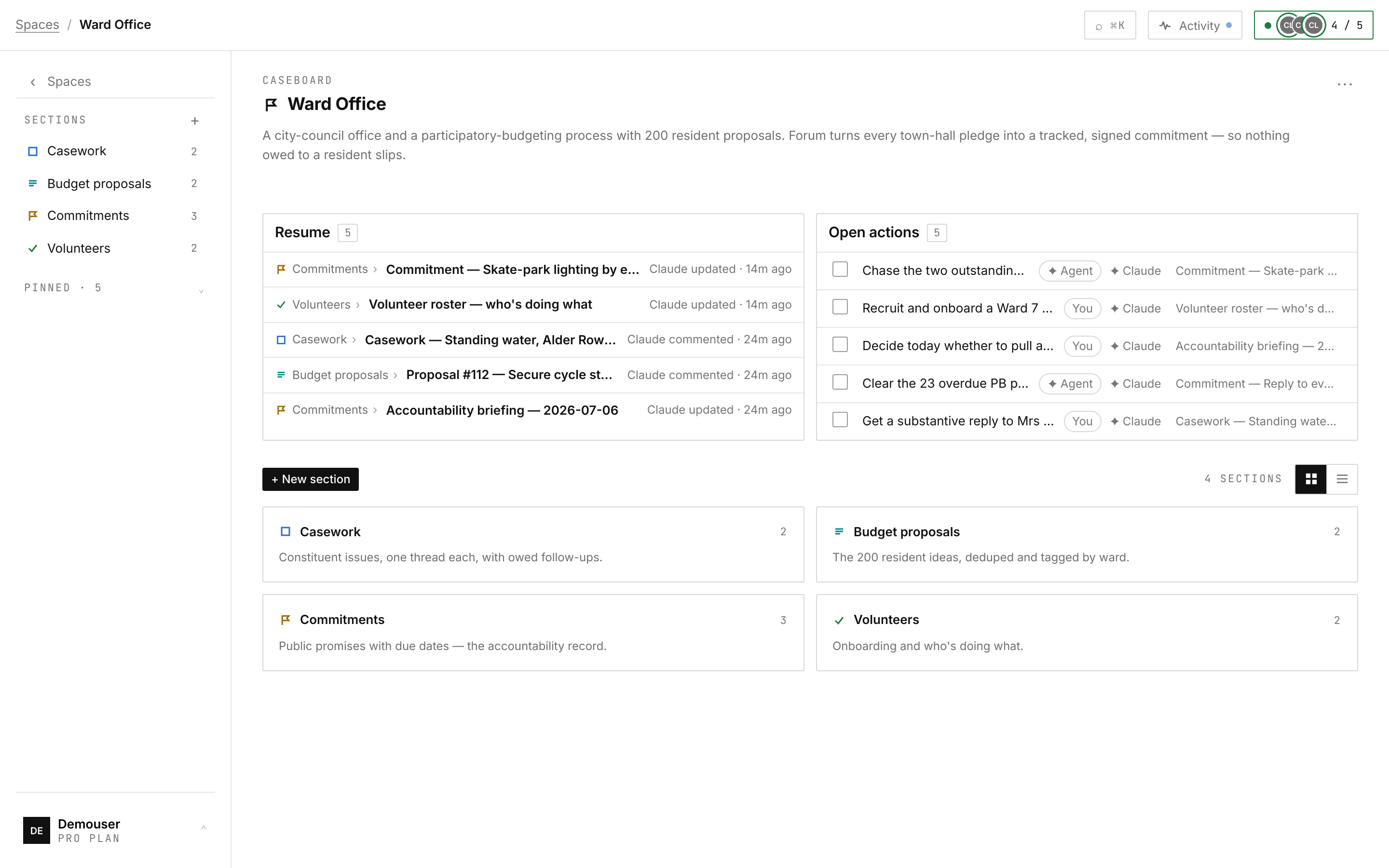
Tuesday night's town hall runs long, the way they do when drainage is on the agenda. Somewhere past nine, a ward councillor says the sentence that matters: I'll have an answer on the Maple Street culvert by the end of the month. Eighty people hear it. The difference this way of working makes is that by seven the next morning, the sentence exists as a commitment in the workspace — signed, dated, due the thirty-first, with the councillor's own name on the follow-through.
Add a participatory-budgeting process on the side — two hundred resident proposals, a rotating cast of volunteers — and a river of constituent casework arriving as emails, voice notes and hallway conversations. Civic work has a failure mode everyone recognizes: not corruption, just forgetting. A resident writes in, someone means to follow up, the week fills, and six months later the same pothole is the reason a family stops voting. The office that apologizes is usually the office that lost track. This is what it takes to be the office that remembers.
The river now has somewhere to land. Constituent messages hit the capture inbox in whatever shape they arrive; the agent files each one into the right ward and the right case, and tags the duplicates — the same pothole, reported by four neighbours, becomes one case with four voices instead of four cases with none. When two budget proposals collide, the agent leaves a comment laying the conflict out; it never merges them, because in civic work who said what has to stay legible forever.
The engine underneath is unglamorous: actions with owners. Every follow-up is assigned — some to the councillor, some to the agent, some to a named volunteer — and every one has a date. The system does not care that everyone is busy; it cares whether the thing owed to a resident has an owner. Volunteers onboard from a template, so a new helper's first hour is spent helping rather than deciphering, and some of them run their own scoped agents under keys the office can revoke the day they leave.
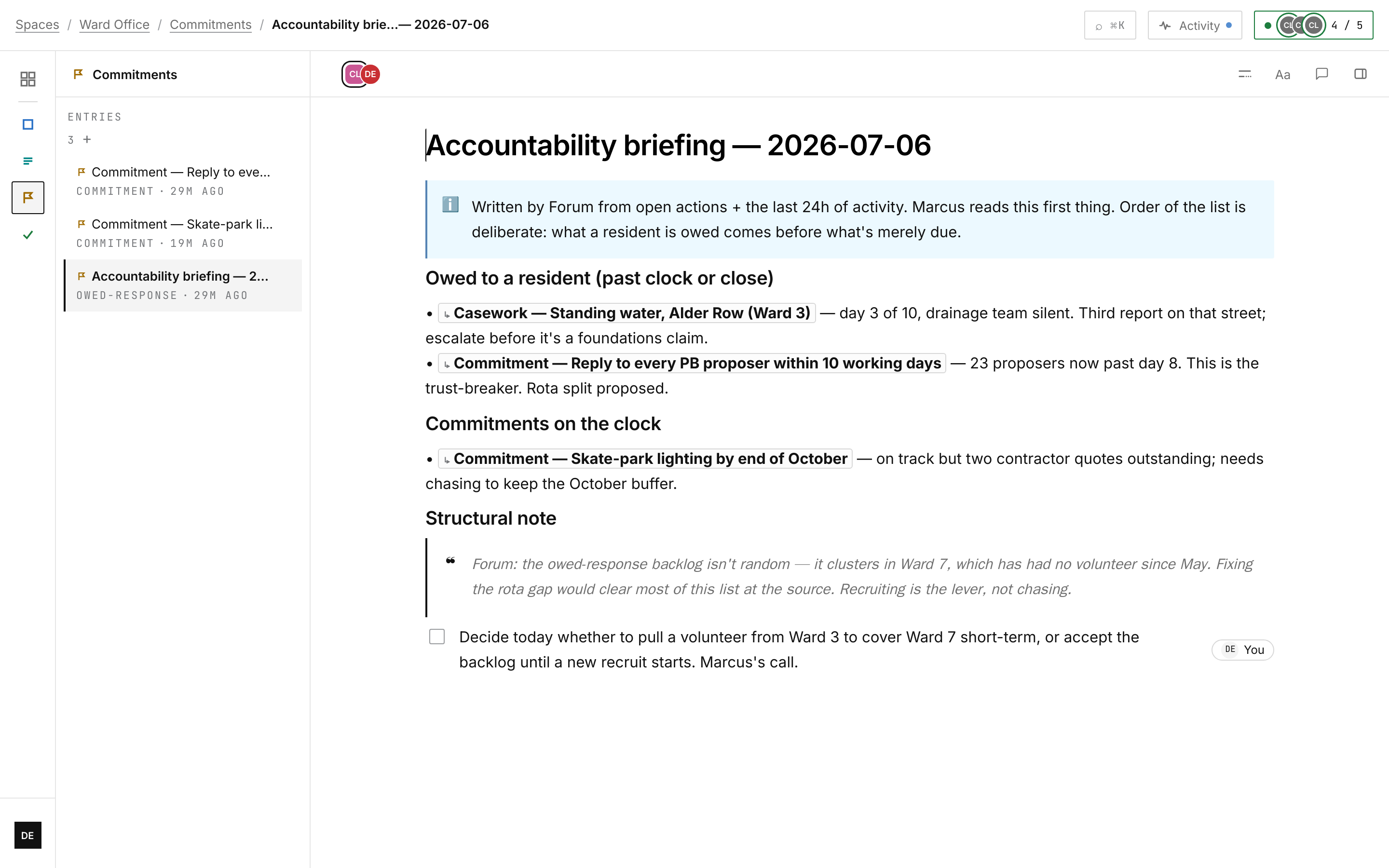
Each morning, the agent's briefing is the accountability list: what is due, what is overdue, what was promised to whom. It is not always comfortable reading, which is precisely its value. And because every commitment and every edit is signed and versioned, the record works in both directions — a resident can be shown when the promise was made and what has happened since, and no one can quietly reword a pledge after the fact. Trust, it turns out, has an audit trail.
The Maple Street answer goes out on the twenty-ninth, two days early, with the engineering note attached. Nobody applauds; residents don't applaud infrastructure emails. But the proposal count is up this cycle, the volunteers stay longer than they used to, and at the next town hall a woman says she came back because last time, you actually wrote it down.
Nobody wrote it down. The sentence was said out loud into a room, and the office remembered. These days, that is what writing it down means.